Showing posts with label Python. Show all posts

Python VS R Latest Trend in the Market


Basic Understanding:
        Day by Day we are going ahead where we are facing big data, it is critical to handle and visualize it in appropriate manner. Different programming languages handles different kind of problem such as (C++, C#) for desktop application, mobile application, web base application, but in the domain of programming language R and Python are old languages R designed on August 1993; and Python in 1991 but its impressive libraries emphases us to use it for big data (analysis, and predication) where we need to predict and visualization using Artificial Intelligence, machine learning, deep learning also for Data Science (statistical purpose).
In the usage war, both programming language waging each other, action, rule and predication action these two has own importance according to the modern era both language ratio in usage, in 2017 R highlighted in the world by its usage and it unique libraries.


Introduction:
For statistical calculation and graphic R programming language has been used. The R GNU based, which is similar to S language, where it environment designed at Bell Laboratories (formerly AT&T, now Lucent Technologies) by John Chambers and colleagues. Different designing and it implementation of S can be considered as R. Both not be, same there are many difference between S and R in other work. Also, R bestrew big range of different statistical related modeling, classical statistical test, time s series analysis, classification, clustering function etc…and related graphical techniques, which are nightly extensible, whereas S provide the research statistical methodology, and R provides the open source route to participation in the activity.
For R, it is very easy to formulate the mathematical symbols and drawing the plot using well designed publication. These graphic design by default running possibilities present in window, Unix and related platforms available on it.
R as Programming LanguageIt is the Open source counterpart of SAS, traditionally been used in academics and research. It is open source nature basically, latest techniques get released quickly. There is a lot of documentation available over the internet and it is a very cost-effective option.

Python as Programming Language: It is an open source scripting language as like others,  It is one of the growing language. These days, it stunning libraries (scipy, numpy and matplotlib) and functions for almost any statistical operation / model building you may want to do. Also using of pandas showing the file handing in very smart way for data handing and others related mathematical models work.
R is traditionally open source programming language, which is not only used in data science field but also in different field of life.
           In term of differences and opponent there are a lot of differences between them to shows the grow of that language in the different field in this ear, such as data science, machine learning, data science and data analyst, but In the Article I am going to discuss TEN differences which effect to grow and popularity reason of R and Python in the globe.
Let's understand these differences:


History
    Python is an interpreted high-level programming language for general-purpose programming, which has been created by Guido van Rossum in 1991, The two version (2.0 and 3.0) of python create conflict between the user, and from these two others sub version is going to created time to time (2.7 or 3.2), right now the current latest version (as of Fall 2018) is Python 3.6.4. Whereas in R is a programming language as like other it is free environment for statistical computing and also support for graphic which has been designed by Ross Ihaka and Robert Gentleman in 1995, the latest version of R which is running in market is  3.5.1 which is available on the official website of R to download.
Community
   The main purpose of community to provide help as quick service. There are different community available to provide stunning performance to produce stage as community like on R website community,  Stackoverflow, Mailing list, user contributed code and documentation also different developer and programmer create own community to held it up. Whereas in R community Mailing list, user contributed code and documentation and Active stackoverflow members few data scientist and statisticians also provide the huge community as compare to python which grow more result then python popularity.
Purpose
    Python always force on productivity and code readability and usability because it is an Object oriented language. It is English related keyword supported language (logical operator AND, OR AND NOT). Also not only folks use it to make better programming also use it for gaming by using PyGame library. Whereas in R, it is focus on Data to fix, predict, analysis and deep concept of statistic and graphic model for graph related plotting.
Usability
    As we discuss about the syntax of Python for coding is easy because several keyword and writing tool related to English easy word, that’s why running and debugging is easy. Also, Indentation of code effect on it meaning, we must follow the pattern of python in term writing function (in the predefine way). Where as in R statistic related model can be written in few lines. Also, function can be written using several way as compare to python. R is generally suitable for any type of data analysis. The numerous number of packages and readily usable tests make starting any analysis quite easy as computer to python.
Flexibility
          In term of flexibility of python, it is more flexibility, we do new any time on it which is never did on before. Many user use it as scripting language also for web development. Python use to analysis project is part of a bigger project that involves many complexities easily. Where as in R, for data science in deep many developer prefer to use R then Python due to its powerful libraries also helpful to analysis complex data using huge list of R packages and statistical model.
Ease of learning
         In the field of computer programming, many developer prefer to build their logic first, for this many computer scientist to learn first Python, that’s why in different educational centers python has been taught as level first. For ease in the python learning, readability and usability make it easier for basic and easy to learn as compare to R. But also R is not hard for experience programmer.
Job Scenario
        According to the latest trends and report, R and Python are the competitive to each other, Last TWO Year the Popularity of Python is grow up then R, but we cannot ignore the popularity of R as well. Most of the companies follow the usage of R and python both for big data handling and data analysis. Accordingly the jobs setup change time to time in term of salary and also work on.
The jobs, ad in USA in 2017, through the website have a look!
Search by "Data Scientist" finds 3,558 jobs
Search by "Data Scientist" Python finds 2,407 jobs (68% of all)
Search by "Data Scientist" R finds 2,179 (61% of all).
Search by "Data Scientist" Python R finds 1,906 jobs (54% of all) and
Search for "Data Scientist" -Python -R finds 892 jobs (25% of all)
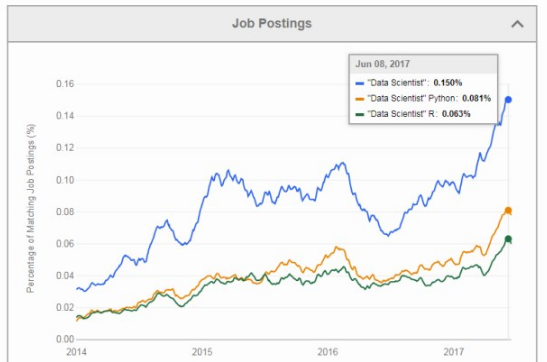
Also, the job and salaries graphs demonstrate this senses is easy way: The first one is showing the popularity of Python over R, second for Python as data science also third one shows for the same in ratio in June of 2017.



Data Handling
           For data handling I do not see any big differences between them which shows the realist effect on any programming language. Both handle the data by using libraries, Python use Numpy and Pandas to cover and handle the data in easy and sufficient way, whereas in R we do not need to install libraries for basic data handling but for big data and other advance work we need to install it like data.table and dplyr and others.
IDE support
        IDE means integrated development environment, for support of programming language coding and environment to run we need IDE according the related programming language like C/C++ Dev, C# Visual Studio. As like these For Python there are different IDE to code few of them which are most famous these days, Pycham, IPython Notebook, Spyder and Rodeo, where as in R the famous one is only RStudio.
Libraries
         Library is the collection of classes which provide the short way to code and get to required output using few line of code. In Python there are different libraries in this Article we will discuss main and famous of them, Pandas which is used to manipulate the date, Scipy and Numpy are used for scientific work and calculation. For graph we used matplotlib, and using statsmodels we explore the data, create the statistical modem and also perform different statistical test and unit test. Whereas in R different packages play a vital rule to make R more attractive in term of usage, dplyr, plyr and data.table are used to manipulate the date as like python, stringr is used to manipulate the string. Zoo not for (zoo) J but for working in regular and irregular time series. Ggvis, lattice and ggplot2 are used to visualize the date and caret for working on machine learning.

These all are the few differences which I observed
in the field and working by Research!
I am hopeful it will be informative for all of you!!!

Python VS R Latest Trend in the Market


Basic Understanding:
        Day by Day we are going ahead where we are facing big data, it is critical to handle and visualize it in appropriate manner. Different programming languages handles different kind of problem such as (C++, C#) for desktop application, mobile application, web base application, but in the domain of programming language R and Python are old languages R designed on August 1993; and Python in 1991 but its impressive libraries emphases us to use it for big data (analysis, and predication) where we need to predict and visualization using Artificial Intelligence, machine learning, deep learning also for Data Science (statistical purpose).
In the usage war, both programming language waging each other, action, rule and predication action these two has own importance according to the modern era both language ratio in usage, in 2017 R highlighted in the world by its usage and it unique libraries.


Introduction:
For statistical calculation and graphic R programming language has been used. The R GNU based, which is similar to S language, where it environment designed at Bell Laboratories (formerly AT&T, now Lucent Technologies) by John Chambers and colleagues. Different designing and it implementation of S can be considered as R. Both not be, same there are many difference between S and R in other work. Also, R bestrew big range of different statistical related modeling, classical statistical test, time s series analysis, classification, clustering function etc…and related graphical techniques, which are nightly extensible, whereas S provide the research statistical methodology, and R provides the open source route to participation in the activity.
For R, it is very easy to formulate the mathematical symbols and drawing the plot using well designed publication. These graphic design by default running possibilities present in window, Unix and related platforms available on it.
R as Programming LanguageIt is the Open source counterpart of SAS, traditionally been used in academics and research. It is open source nature basically, latest techniques get released quickly. There is a lot of documentation available over the internet and it is a very cost-effective option.

Python as Programming Language: It is an open source scripting language as like others,  It is one of the growing language. These days, it stunning libraries (scipy, numpy and matplotlib) and functions for almost any statistical operation / model building you may want to do. Also using of pandas showing the file handing in very smart way for data handing and others related mathematical models work.
R is traditionally open source programming language, which is not only used in data science field but also in different field of life.
           In term of differences and opponent there are a lot of differences between them to shows the grow of that language in the different field in this ear, such as data science, machine learning, data science and data analyst, but In the Article I am going to discuss TEN differences which effect to grow and popularity reason of R and Python in the globe.
Let's understand these differences:


History
    Python is an interpreted high-level programming language for general-purpose programming, which has been created by Guido van Rossum in 1991, The two version (2.0 and 3.0) of python create conflict between the user, and from these two others sub version is going to created time to time (2.7 or 3.2), right now the current latest version (as of Fall 2018) is Python 3.6.4. Whereas in R is a programming language as like other it is free environment for statistical computing and also support for graphic which has been designed by Ross Ihaka and Robert Gentleman in 1995, the latest version of R which is running in market is  3.5.1 which is available on the official website of R to download.
Community
   The main purpose of community to provide help as quick service. There are different community available to provide stunning performance to produce stage as community like on R website community,  Stackoverflow, Mailing list, user contributed code and documentation also different developer and programmer create own community to held it up. Whereas in R community Mailing list, user contributed code and documentation and Active stackoverflow members few data scientist and statisticians also provide the huge community as compare to python which grow more result then python popularity.
Purpose
    Python always force on productivity and code readability and usability because it is an Object oriented language. It is English related keyword supported language (logical operator AND, OR AND NOT). Also not only folks use it to make better programming also use it for gaming by using PyGame library. Whereas in R, it is focus on Data to fix, predict, analysis and deep concept of statistic and graphic model for graph related plotting.
Usability
    As we discuss about the syntax of Python for coding is easy because several keyword and writing tool related to English easy word, that’s why running and debugging is easy. Also, Indentation of code effect on it meaning, we must follow the pattern of python in term writing function (in the predefine way). Where as in R statistic related model can be written in few lines. Also, function can be written using several way as compare to python. R is generally suitable for any type of data analysis. The numerous number of packages and readily usable tests make starting any analysis quite easy as computer to python.
Flexibility
          In term of flexibility of python, it is more flexibility, we do new any time on it which is never did on before. Many user use it as scripting language also for web development. Python use to analysis project is part of a bigger project that involves many complexities easily. Where as in R, for data science in deep many developer prefer to use R then Python due to its powerful libraries also helpful to analysis complex data using huge list of R packages and statistical model.
Ease of learning
         In the field of computer programming, many developer prefer to build their logic first, for this many computer scientist to learn first Python, that’s why in different educational centers python has been taught as level first. For ease in the python learning, readability and usability make it easier for basic and easy to learn as compare to R. But also R is not hard for experience programmer.
Job Scenario
        According to the latest trends and report, R and Python are the competitive to each other, Last TWO Year the Popularity of Python is grow up then R, but we cannot ignore the popularity of R as well. Most of the companies follow the usage of R and python both for big data handling and data analysis. Accordingly the jobs setup change time to time in term of salary and also work on.
The jobs, ad in USA in 2017, through the website have a look!
Search by "Data Scientist" finds 3,558 jobs
Search by "Data Scientist" Python finds 2,407 jobs (68% of all)
Search by "Data Scientist" R finds 2,179 (61% of all).
Search by "Data Scientist" Python R finds 1,906 jobs (54% of all) and
Search for "Data Scientist" -Python -R finds 892 jobs (25% of all)
Also, the job and salaries graphs demonstrate this senses is easy way: The first one is showing the popularity of Python over R, second for Python as data science also third one shows for the same in ratio in June of 2017.


Data Handling
           For data handling I do not see any big differences between them which shows the realist effect on any programming language. Both handle the data by using libraries, Python use Numpy and Pandas to cover and handle the data in easy and sufficient way, whereas in R we do not need to install libraries for basic data handling but for big data and other advance work we need to install it like data.table and dplyr and others.
IDE support
        IDE means integrated development environment, for support of programming language coding and environment to run we need IDE according the related programming language like C/C++ Dev, C# Visual Studio. As like these For Python there are different IDE to code few of them which are most famous these days, Pycham, IPython Notebook, Spyder and Rodeo, where as in R the famous one is only RStudio.
Libraries
         Library is the collection of classes which provide the short way to code and get to required output using few line of code. In Python there are different libraries in this Article we will discuss main and famous of them, Pandas which is used to manipulate the date, Scipy and Numpy are used for scientific work and calculation. For graph we used matplotlib, and using statsmodels we explore the data, create the statistical modem and also perform different statistical test and unit test. Whereas in R different packages play a vital rule to make R more attractive in term of usage, dplyr, plyr and data.table are used to manipulate the date as like python, stringr is used to manipulate the string. Zoo not for (zoo) J but for working in regular and irregular time series. Ggvis, lattice and ggplot2 are used to visualize the date and caret for working on machine learning.

These all are the few differences which I observed
in the field and working by Research!
I am hopeful it will be informative for all of you!!!

Latest Market trend of Python in the Globe

Python's Journey:  Latest market Trends
Python was conceived in the late 1980s,  and its implementation began in December 1989 by Guido van Rossum at Centrum Wiskunde & Informatica (CWI) in the Netherlands as a successor to the ABC language (itself inspired by SETL)  capable of exception handling and interfacing with the Amoeba operating system. Van Rossum remains Python's principal author. His continuing central role in Python's development is reflected in the title given to him by the Python community: Benevolent Dictator For Life (BDFL).
On the origins of Python, Van Rossum wrote in 1996:
In December 1989, I was looking for a "hobby" programming project that would keep me occupied during the week around Christmas. My office ... would be closed, but I had a home computer, and not much else on my hands. I decided to write an interpreter for the new scripting language I had been thinking about lately: a descendant of ABC that would appeal to Unix/Chackers. I chose Python as a working title for the project, being in a slightly irreverent mood (and a big fan of Monty Python's Flying Circus).


— Guido van Rossum [wikipedia.org]

Python 2.0 Software or any app follow the policy of market and software engineering approach, therefore it launch different version according to the need, the Python 2.0 was released on 16 October 2000 including the new features, also get support of a cycle-detecting garbage collector and support for Unicode. By this feature, the process of development get transparent.


Python 3.0 It was released on 3 December 2008 long testing period after, (initially called Python 3000 or py3k). Major revision of the language that is not completely backward-compatible with previous versions. However, many of its major features have been back ported to the Python 2.6.x and 2.7.x version series, and releases of Python 3 include the 2to3 utility, which automates the translation of Python 2 code to Python 3.
According to the wikipedia , Python 2.7's end-of-life date was initially set at 2015, then postponed to 2020 out of concern that a large body of existing code could not easily be forward-ported to Python 3. Google announced work on a Python 2.7 to Go transcompiler to improve performance under concurrent workloada, In January 2017,[wikipedia.org]
  
As a Language:

Python is an interpreted high-level programming language for general-purpose programming. Created by Guido van Rossum and first released in 1991, Python has a design philosophy that emphasizes code readability, notably using significant whitespace. It provides constructs that enable clear programming on both small and large scales. it is used for;
  • web development (server-side),
  • software development,
  • mathematics,
  • system scripting.
 Python can do a lot of think in term of computer programming languages such as;
  • Python can be used on a server to create web applications.
  • Python can be used alongside software to create workflows.
  • Python can connect to database systems. It can also read and modify files.
  • Python can be used to handle big data and perform complex mathematics.
  • Python can be used for rapid prototyping, or for production-ready software development.

Features Among others:


Python features a dynamic type system and automatic memory management. It supports multiple programming paradigms, including object-orientedimperativefunctional and procedural, and has a large and comprehensive standard library.
Python interpreters are available for many operating systemsPython, the reference implementation of Python, is open source software and has a community-based development model, as do nearly all of its variant implementations. C Python is managed by the non-profit Python Software Foundation[wikipedia.org]
The reason for usage of python is also for different easiest scenarios like;
  • Python works on different platforms (Windows, Mac, Linux, Raspberry Pi, etc).
  • Python has a simple syntax similar to the English language.
  • Python has syntax that allows developers to write programs with fewer lines than some other programming languages.
  • Python runs on an interpreter system, meaning that code can be executed as soon as it is written. This means that prototyping can be very quick.
  • Python can be treated in a procedural way, an object-orientated way or a functional way.

Libraries: Python's large standard library, commonly cited as one of its greatest strengths, provides tools suited to many tasks. For Internet-facing applications, many standard formats and protocols such as MIME and HTTP are supported. It includes modules for creating graphical user interfaces, connecting to relational databasesgenerating pseudorandom numbers, arithmetic with arbitrary precision decimals, manipulating regular expressions, and unit testing.


Some parts of the standard library are covered by specifications (for example, the Web Server Gateway Interface (WSGI) implementation wsgiref follows PEP 333), but most modules are not. They are specified by their code, internal documentation, and test suites (if supplied). However, because most of the standard library is cross-platform Python code, only a few modules need altering or rewriting for variant implementations.
As of March 2018, the Python Package Index (PyPI), the official repository for third-party Python software, contains over 130,000 packages with a wide range of functionality [wikipedia.org], including:

  • ·         Graphical user interfaces
  • ·         Web frameworks
  • ·         Multimedia
  • ·         Databases
  • ·         Networking
  • ·         Test frameworks
  • ·         Automation
  • ·         Web scraping
  • ·         Documentation
  • ·         System administration
  • ·         Scientific computing
  • ·         Text processing
  • ·         Image processing

Development environments:
See also: Comparison of integrated development environments § Python Most Python implementations (including CPython) include a read–eval–print loop (REPL), permitting them to function as a command line interpreter for which the user enters statements sequentially and receives results immediately. Other shells, including IDLE and IPython, add further abilities such as auto-completion, session state retention and syntax highlighting. As well as standard desktop integrated development environments (see Wikipedia's "Python IDE" article), there are Web browser-based IDEs; SageMath (intended for developing science and math-related Python programs); PythonAnywhere, a browser-based IDE and hosting environment; and Canopy IDE, a commercial Python IDE emphasizing scientific computing. [wikipedia.org]

Good to now about:
·        The most recent major version of Python is Python 3, which we shall be using in this Post. However, Python 2, although not being updated with anything other than security updates, is still quite popular.
·        It is possible to write Python in an Integrated Development Environment, such as Thonny, Pycharm, Netbeans or Eclipse which are particularly useful when managing larger collections of Python files.

Idea and Usage of Python trends:
Modern technologies like artificial intelligence, machine learning, data science and big data have become the buzzwords which everybody talks about but no one fully understands. Python give great support for them, They seem very complex to a layman. All these buzzwords sound similar to a business executive or student from a non-technical background. People often get confused by words like AI, ML and data science. In this blog, we explain these technologies in simple words so that you can easily understand the difference between them and how there are being used in business.

What is Artificial Intelligence (AI)?
Artificial intelligence refers to the simulation of a human brain function by machines. This is achieved by creating an artificial neural network that can show human intelligence. The primary human functions that an AI machine performs include logical reasoning, learning and self-correction. Artificial intelligence is a wide field with many applications but it also one of the most complicated technology to work on. Machines inherently are not smart and to make them so, we need a lot of computing power and data to empower them to simulate human thinking.

Artificial intelligence is classified into two parts, general AI and Narrow AI. General AI refers to making machines intelligent in a wide array of activities that involve thinking and reasoning. Narrow AI, on the other hand, involves the use of artificial intelligence for a very specific task. For instance, general AI would mean an algorithm that is capable of playing all kinds of board game while narrow AI will limit the range of machine capabilities to a specific game like chess or scrabble. Currently, only narrow AI is within the reach of developers and researchers. General AI is just a dream of researchers and perception among the masses that will take a lot of time for the human race to achieve (if ever possible).

What is Machine Learning?
Machine learning is the ability of a computer system to learn from the environment and improve itself from experience without the need for any explicit programming. Machine learning focuses on enabling algorithms to learn from the data provided, gather insights and make predictions on previously unanalyzed data using the information gathered. Machine learning can be performed using multiple approaches. The three basic models of machine learning are supervised, unsupervised and reinforcement learning.

In case of supervised learning, labeled data is used to help machines recognize characteristics and use them for future data. For instance, if you want to classify pictures of cats and dogs then you can feed the data of a few labeled pictures and then the machine will classify all the remaining pictures for you.  On the other hand, in unsupervised learning, we simply put unlabeled data and let machine understand the characteristics and classify it. Reinforcement machine learning algorithms interact with the environment by producing actions and then analyze errors or rewards. For example, to understand a game of chess an ML algorithm will not analyze individual moves but will study the game as a whole.Read More: Descriptive vs. Predictive vs. Prescriptive Analytics.

What is Data Science?
Data science is the extraction of relevant insights from data. It uses various techniques from many fields like mathematics, machine learning, computer programming, statistical modeling, data engineering and visualization, pattern recognition and learning, uncertainty modeling, data warehousing, and cloud computing. Data Science does not necessarily involve big data, but the fact that data is scaling up makes big data an important aspect of data science.


Data science is the most widely used technique among AI, ML and itself. The practitioners of data science are usually skilled in mathematics, statistics, and programming (although expertise in all three is not required). Data scientists solve complex data problems to bring out insights and correlation relevant to a business.


AI and its Sub parts:
Artificial intelligence is a very wide term with applications ranging from robotics to text analysis. It is still a technology under evolution and there are arguments of whether we should be aiming for high-level AI or not. Machine learning is a subset of AI that focuses on a narrow range of activities. It is, in fact, the only real artificial intelligence with some applications in real-world problems.
Data science isn’t exactly a subset of machine learning but it uses ML to analyze data and make predictions about the future. It combines machine learning with other disciplines like big data analytics and cloud computing. Data science is a practical application of machine learning with a complete focus on solving real-world problems.
At New Gen Apps, we focus on developing new age solutions that leverage these technologies and help you solve real-world business problems. If you are looking for a company that can make sense out of your data and gives you insights that matter to your business then feel free to get in touch.

Learning Python:
         Python is an easy to learn, powerful programming language. It has efficient high-level data structures and a simple but effective approach to object-oriented programming. Python’s elegant syntax and dynamic typing, together with its interpreted nature, make it an ideal language for scripting and rapid application development in many areas on most platforms. The Python interpreter and the extensive standard library are freely available in source or binary form for all major platforms from the Python Web site, https://www.python.org/, and may be freely distributed. The same site also contains distributions of and pointers to many free third party Python modules, programs and tools, and additional documentation.

Concept and Internal Knowledge:
The Python interpreter is easily extended with new functions and data types implemented in C or C++ (or other languages callable from C). Python is also suitable as an extension language for customizable applications. This Post introduces the reader informally to the basic concepts and features of the Python language and system. It helps to have a Python interpreter handy for hands-on experience, but all examples are self-contained, so the Post can be read off-line as well.
For a description of standard objects and modules, see The Python Standard LibraryThe Python Language Reference gives a more formal definition of the language. To write extensions in C or C++, read Extending and Embedding the Python Interpreter and Python/C API Reference Manual. There are also several books covering Python in depth.

Learning link:
  For latest and easiest way to learn python through   book
  you can visit the below link:

  Also, for learning Python form very beginner level    you can join the blog: